Localized React Context State Architecture
The Over-Globalized State Trap
When building highly complex UI elements—like an advanced Kanban Board or an interactive multi-step data mapping wizard—component state can get messy quickly. A common mistake among React and Next.js developers is reaching for a massive global state manager (like Redux, Zustand, or a root-level React Context) to coordinate everything.
While global state has its place (like tracking user authentication or a dark mode toggle), throwing highly feature-specific state into a global store is a massive architectural flaw. It creates severe **Prop Drilling** if handled manually, or triggers massive **Unnecessary Re-renders** across the entire application every time a user drags a single item across a dashboard. To keep your frontend optimized, you must isolate state strictly to the subtree that owns it.
The Solution: Localized Context Providers
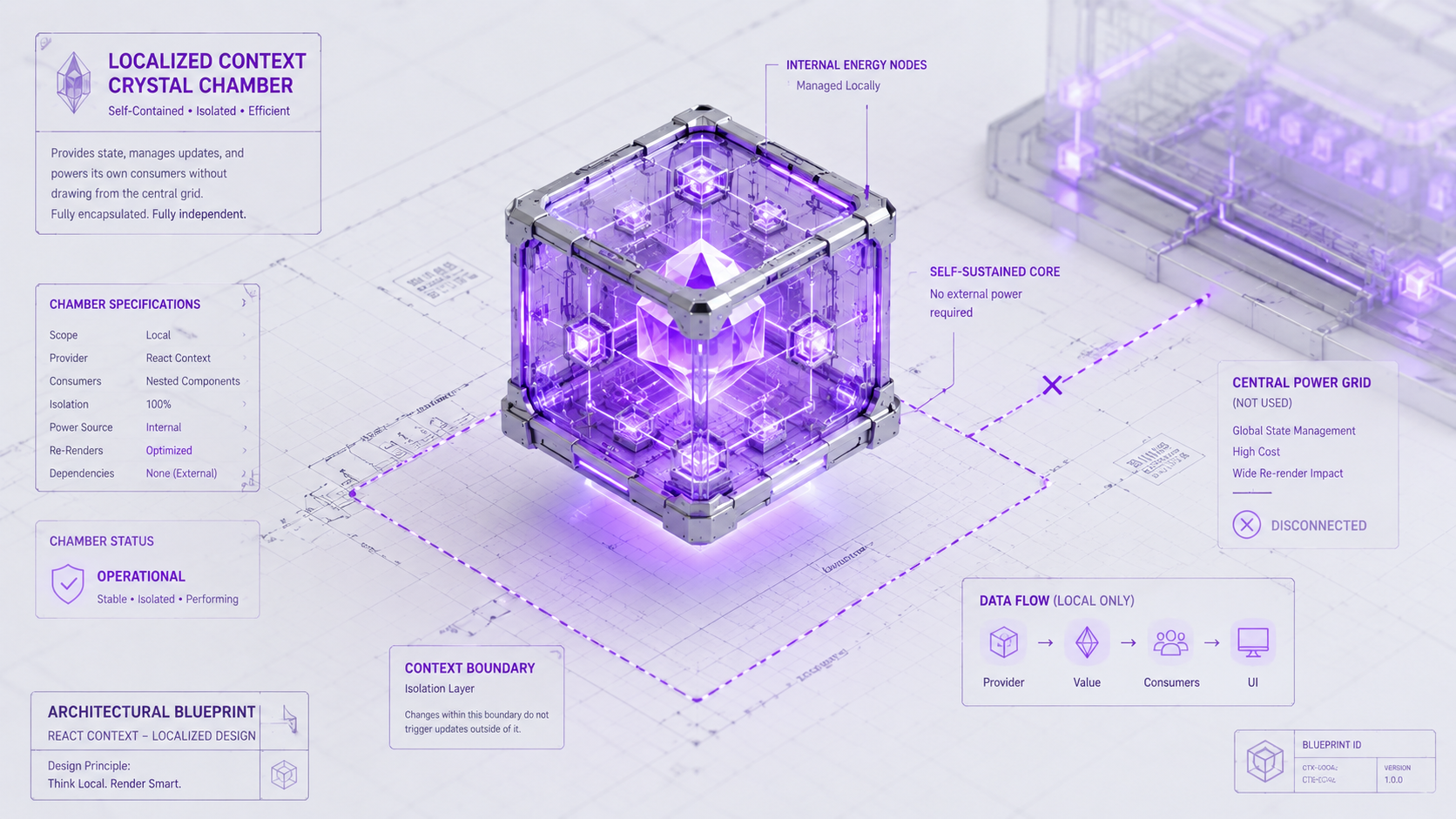
At Smart Tech Devs, we follow a strict encapsulation rule: Feature state should stay with the feature.
Instead of registering your complex sub-states globally, you wrap that specific dashboard module inside a highly targeted, local React Context. This gives you all the benefits of clean state consumption without polluting the root application or triggering global re-renders.
Step 1: Architecting the Local Feature State
Let's build an isolated state controller for an intricate multi-step form widget. This context lives completely inside its own folder module.
// features/wizard/context/WizardContext.tsx
"use client";

import React, { createContext, useContext, useState } from 'react';

interface WizardState {
    step: number;
    formData: Record;
    nextStep: () => void;
    updateData: (data: Record) => void;
}

const WizardContext = createContext<WizardState | undefined>(undefined);

export function WizardProvider({ children }: { children: React.ReactNode }) {
    const [step, setStep] = useState(1);
    const [formData, setFormData] = useState({});

    const nextStep = () => setStep((s) => s + 1);
    const updateData = (data: Record) => setFormData((f) => ({ ...f, ...data }));

    return (
        <WizardContext.Provider value={{ step, formData, nextStep, updateData }}>
            {children}
        </WizardContext.Provider>
    );
}

// Custom hook for consumption within the localized tree
export function useWizard() {
    const context = useContext(WizardContext);
    if (!context) {
        throw new Error("useWizard must be used within a localized WizardProvider");
    }
    return context;
}
Step 2: Scoping the Feature Layout
Now, we mount the provider strictly at the entry point of our feature widget, completely shielding the rest of our Next.js dashboard layout from the component's internal state updates.
// features/wizard/WizardWidget.tsx
import { WizardProvider } from './context/WizardContext';
import StepTracker from './components/StepTracker';
import FormContent from './components/FormContent';

export default function WizardWidget() {
    return (
        // Encapsulate the feature tree entirely
        <WizardProvider>
            <div className="p-6 bg-white shadow rounded-lg">
                <StepTracker />
                <FormContent />
            </div>
        </WizardProvider>
    );
}
The Architectural Benefits
Let’s analyze why local Context isolation is superior to global tracking for specific features:
Isolated Re-renders: When a user type inside an input inside
FormContent, only the components wrapped inside that specificWizardProviderre-render. The main sidebar, header, and global dashboard components stay perfectly static.Garbage Collection: The moment the user navigates away from the multi-step feature page, the React component unmounts, and the localized memory context is instantly destroyed and wiped clean from the browser's RAM automatically.
Reusability: Because the state management is built directly into the widget tree, you can drop two identical
<WizardWidget />components onto the same page, and they will run independently without interfering with each other's data.
Conclusion
Clean code architecture is built on strict encapsulation. Stop littering your global stores with short-lived, component-specific variables. By treating compound UI elements as self-contained feature nodes with their own local React Context pipelines, you write highly modular frontends that remain blazingly fast at scale.